How to Remove Tree Sap From Your Car (Before It Eats Your Clear Coat)
September 3, 2026

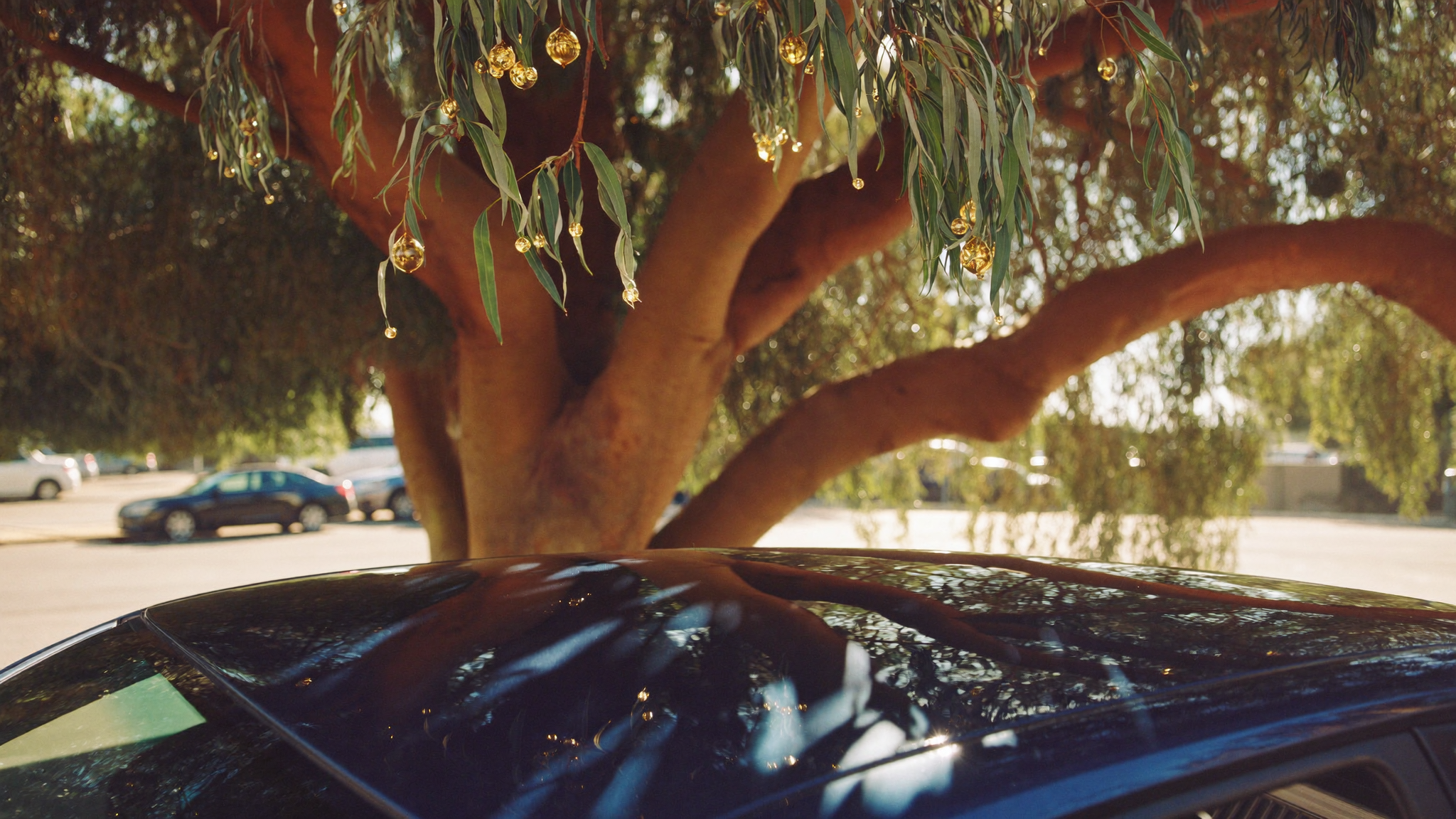
There's a specific little victory that happens in every San Diego parking lot in late summer. You pull in, the asphalt is shimmering, and there it is — the last open spot under the big eucalyptus. You slide in feeling like you beat the system.
You did. Your prize is three amber dots on the hood and a sticky lesson in what I call the shade tax.
I detail cars all over North County, and from July through September, sap removal quietly becomes half my job. So here's the full playbook — how to get sap off without making it worse, how to tell when it's already past the DIY stage, and why the sticky stuff under some trees isn't even sap at all.
Fresh sap is soft, oily, and honestly not a big deal. Give it a week on a hood that hits 150 degrees in the afternoon sun, and it becomes a different animal.
The heat cooks the moisture out and the drop hardens into something like amber glass. As it cures it shrinks, and it takes its grip on your clear coat seriously — some of it will chemically etch its way in while it's at it. A hardened drop even acts like a tiny lens, focusing sunlight on one spot of paint that was already dealing with everything the San Diego sun does on its own.
A sap spot in January is a chore. A sap spot in August is a countdown.
Not all sticky trees are committing the same crime, and it changes how you clean up.
Pine pitch — Torrey pines, Canary Island pines — is the heavyweight. Thick, stringy, smells like Christmas, hardest to remove.
Eucalyptus drops darker little droplets plus a fine sticky mist that settles over the whole panel.
Jacarandas and ficus are the plot twist. That sticky film coating your car after a week under a blooming jacaranda? Mostly not sap. It's honeydew — the polite botanical term for what aphids excrete while feeding in the canopy above your car. Bug juice. You're welcome for that image.
The good news: honeydew is sugar-based and comes off with a proper wash. Actual sap and pitch need chemistry, which is where people start making mistakes.
Your fingernail on a hot panel. You won't pop the drop off — you'll smear it and grind whatever dust is sitting on the paint right through it.
A razor blade on paint. No. Glass has different rules (we'll get there), but a blade on clear coat is a scar with extra steps.
Nail polish remover. Acetone dissolves sap beautifully. It also dissolves the finish on your clear coat. It cannot tell the difference.
A Magic Eraser. It's sandpaper wearing a friendly costume — I've already sacrificed a bumper to that lesson so you don't have to.
Waiting. The one everyone picks. Sap doesn't leave on its own. It moves in.
Step 1: Work cool, and wash first. Move the car into shade or work in the morning — solvents flash off uselessly on a hot panel. Wash the area before you touch anything, because rubbing at sap through a layer of dust is how you scratch a hood while "cleaning" it.
Step 2: Let chemistry do the pulling. Use a dedicated tar-and-sap remover, or 70%+ isopropyl alcohol on a microfiber towel. Press the soaked towel onto the spot and just hold it there for 30 to 60 seconds. Then wipe with a lift, not a scrub. Thick drops come off in layers — re-soak and repeat. The towel should do the waiting; your arm shouldn't do the working.
Step 3: Clay the ghost. A hardened drop usually leaves a rough little shadow behind that you can feel with your fingertips. A clay bar with plenty of lubricant glides that residue right off. If the paint already feels like glass, skip this.
Step 4: Re-protect the spot. This is the step everyone forgets. Alcohol strips the wax or sealant off that section, and unprotected paint is exactly where the next drop digs in fastest. Hit the panel with a coat of spray sealant or wax before you call it done.
Step 5: Glass gets its own rules. Sap remover first, always. Truly baked-on drops on a windshield can take a fresh razor at a low angle — but that trick is for glass only, never for tinted side windows, and never, ever for paint.
Sometimes the drop comes off and leaves a dull ring or a cloudy patch underneath. That's not residue. That's etched clear coat, and no chemical on Earth fixes a texture problem — at that point you're not cleaning anymore, you're polishing, and you've crossed into paint correction territory.
Here's the honest math I give people in driveways every week: the same drop is a ten-minute wipe in week one and machine time by month three. The cheapest version of this repair is always the early one.
You don't have to give up shade. You just have to stop parking blind.
Look up before you commit. A pine or eucalyptus directly overhead is a different bet than a palm or open sky. (Palms drop their own surprises, but sap isn't one of them.)
Do the gas-station hand test. Once a week, run your fingers across the hood while the tank fills. You'll catch drops on day two instead of week six, back when they still wipe off like nothing.
Coatings buy time, not immunity. A ceramic coating doesn't make your car sap-proof — nothing does. But sap sits on top of a coating instead of digging into bare clear coat, releases with way less fight, and gives you weeks of margin instead of days.
And still take the shaded spot. An August interior is an oven, and the sun is not your paint's friend either. Just audit the tree first.
If a drop has already gone crusty on you — or the hood has that full constellation-of-amber look from a summer under the wrong tree — that's exactly the kind of thing we deal with in a full exterior detail, in your driveway, sap and all. Mention which tree did it when you book. We keep score.
The eucalyptus is never going to apologize. Take the shade anyway.
Just look up first — and check your hood on Friday.



ZS Clean is committed to your satisfaction and your comfort. We tailor our service system to make your life simpler and easier—saving you time and giving you peace of mind.